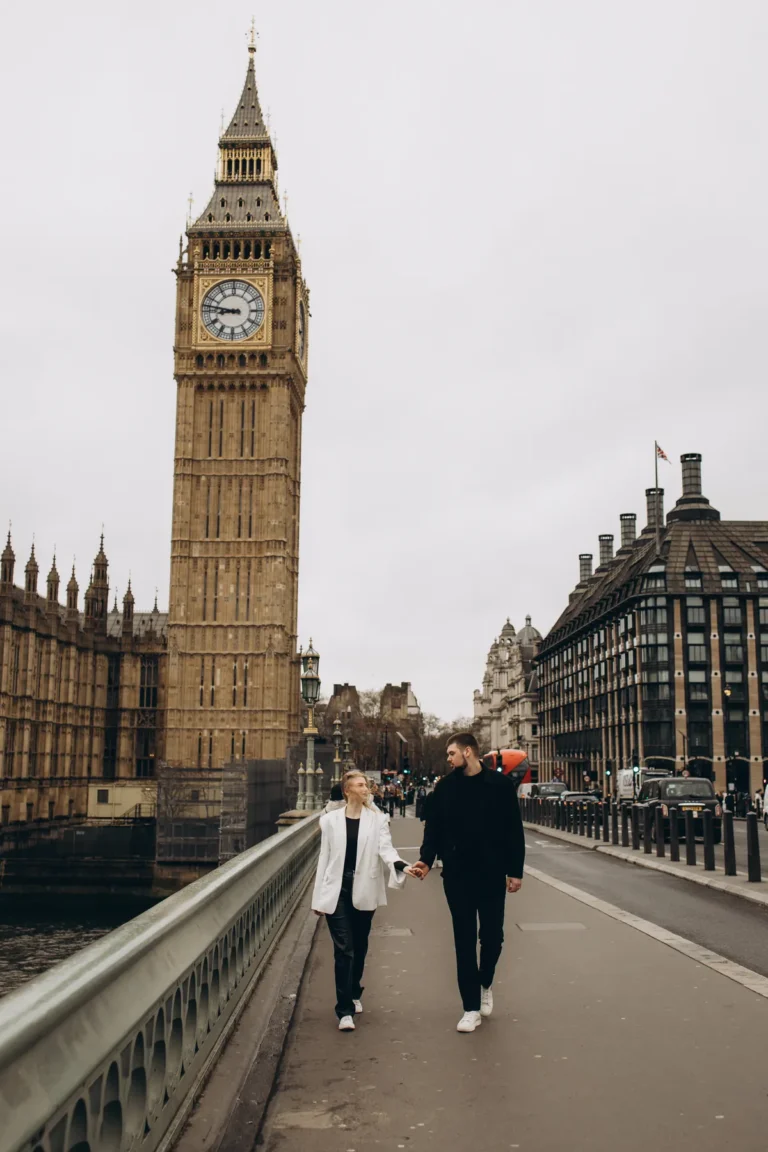
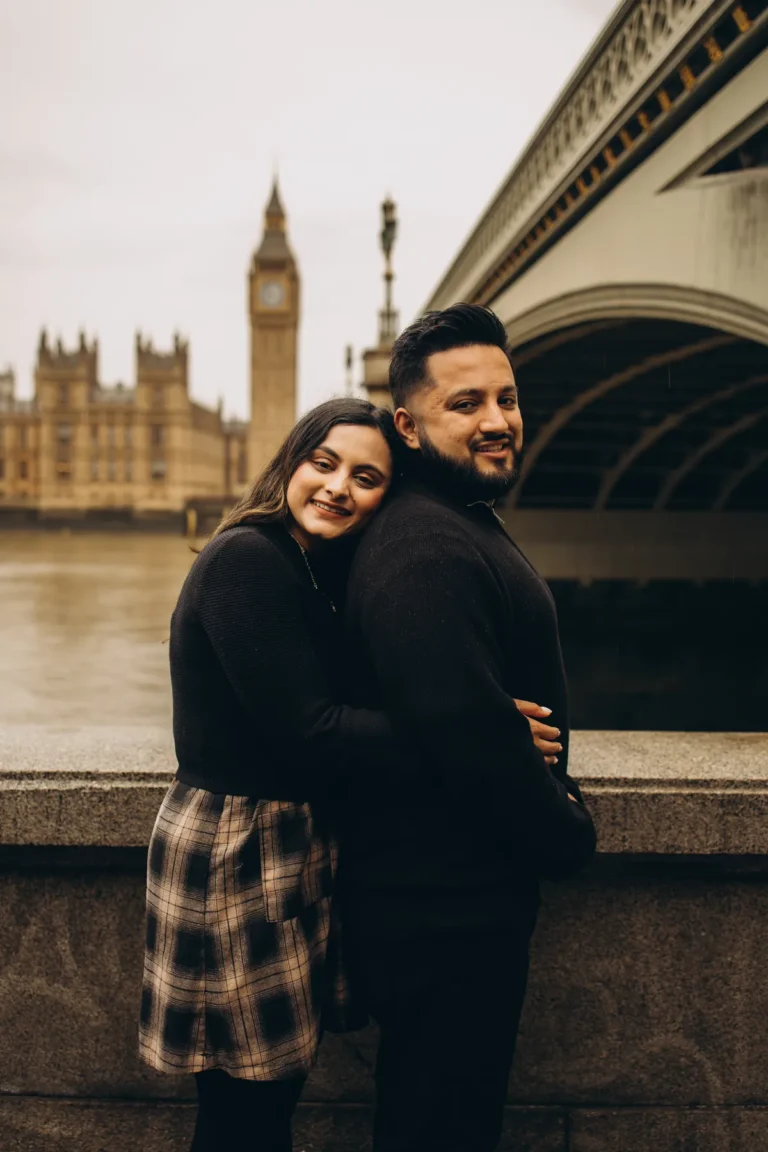
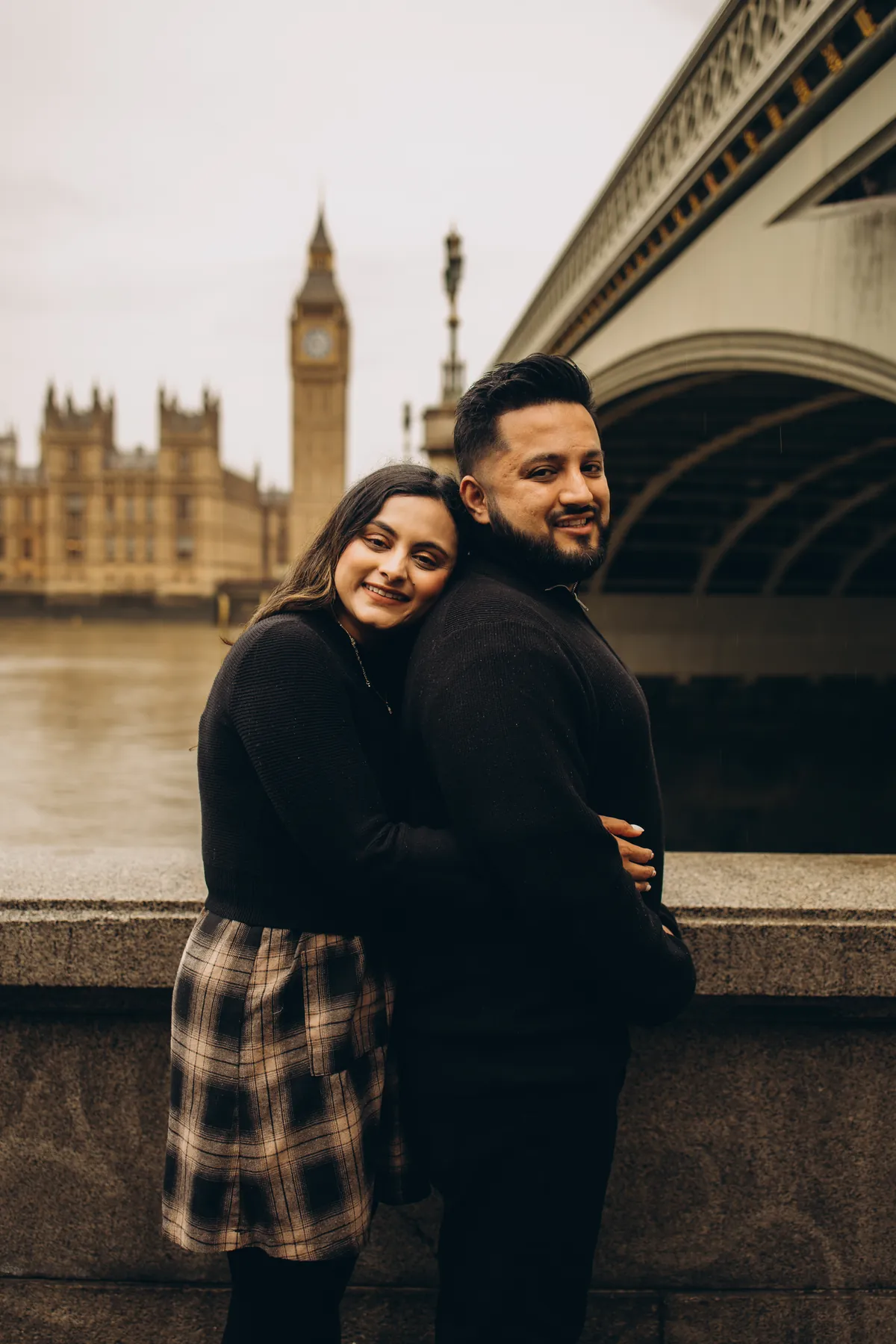
A grey, drizzly day, a plaid skirt, two black jumpers and one clear umbrella. This Big Ben photoshoot started with a portrait each by the red phone box, crossed Westminster Bridge and finished under the arch on the South Bank. Nobody got a sunny day, and nobody needed one.
On this page:
- The red phone box
- A short history of the red phone box
- Across from the London Eye
- Westminster Bridge in the rain
- A portrait each
- The arch and the river wall
- Ideas to borrow
The red phone box
The shoot began at the red phone box just off Parliament Square, with the clock tower at the end of the street and a red double-decker bus behind. She held the door open and picked up the receiver. He leaned on the side of the box with his hands in his pockets. Two very different people, the same box, and both look completely at home.
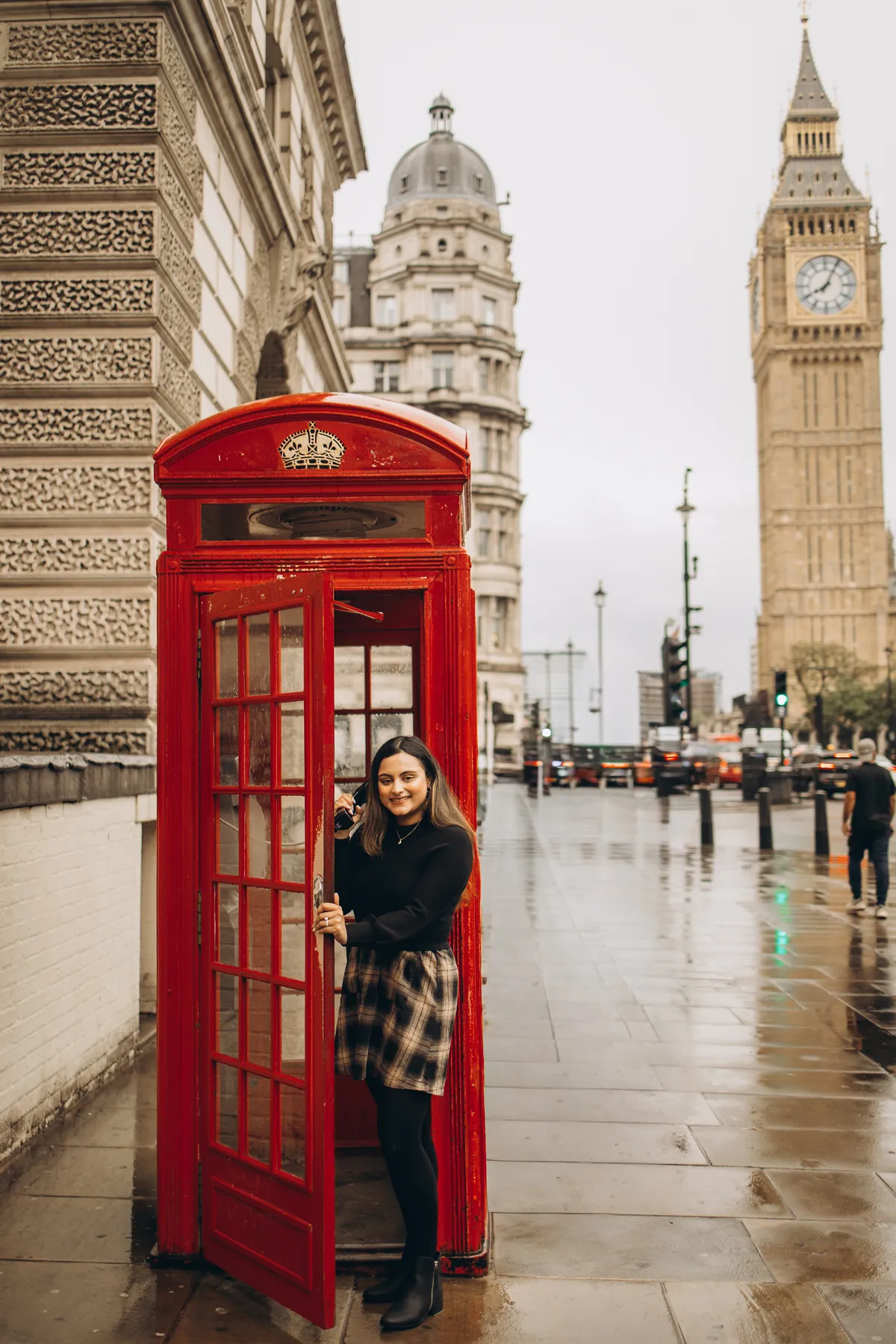
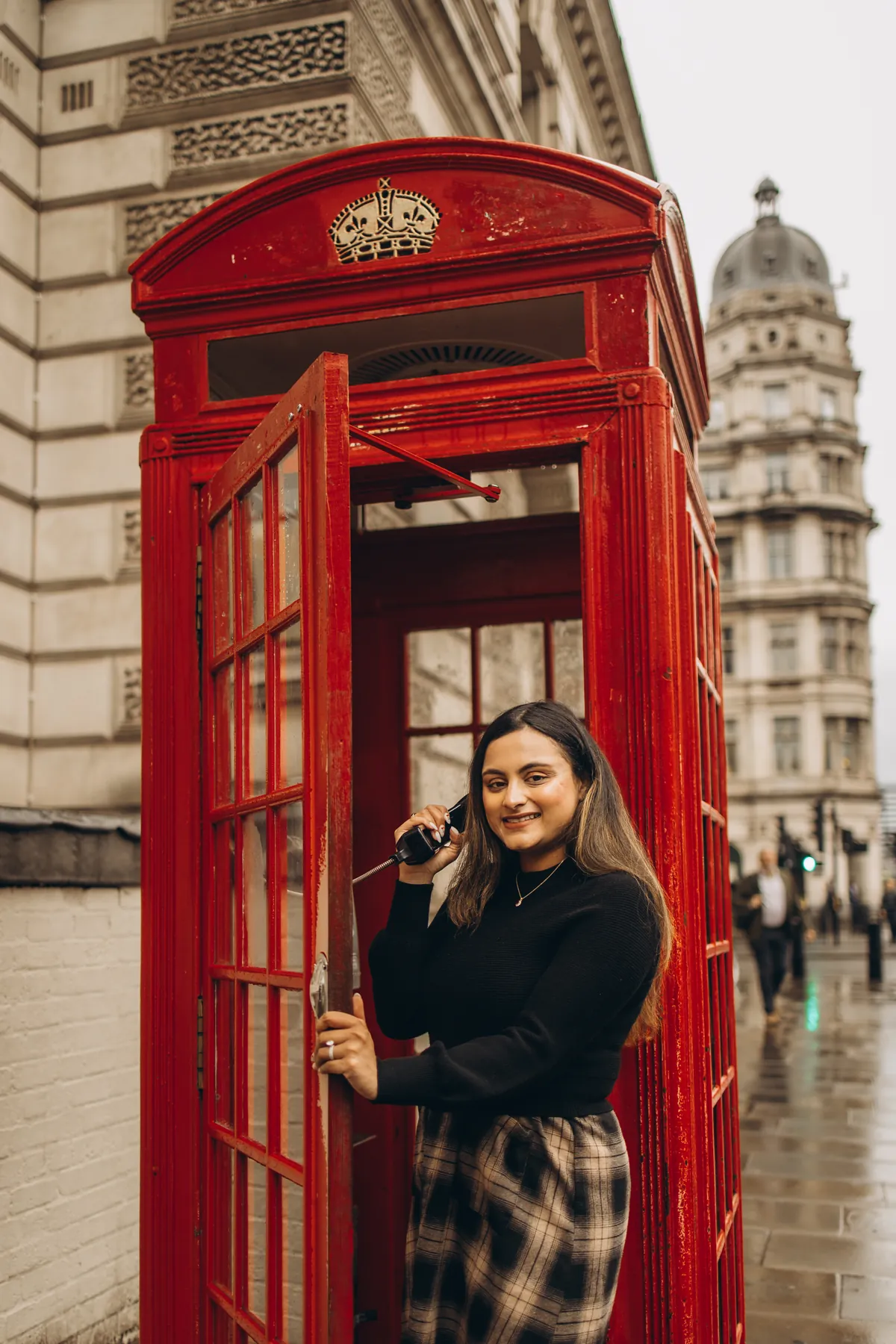
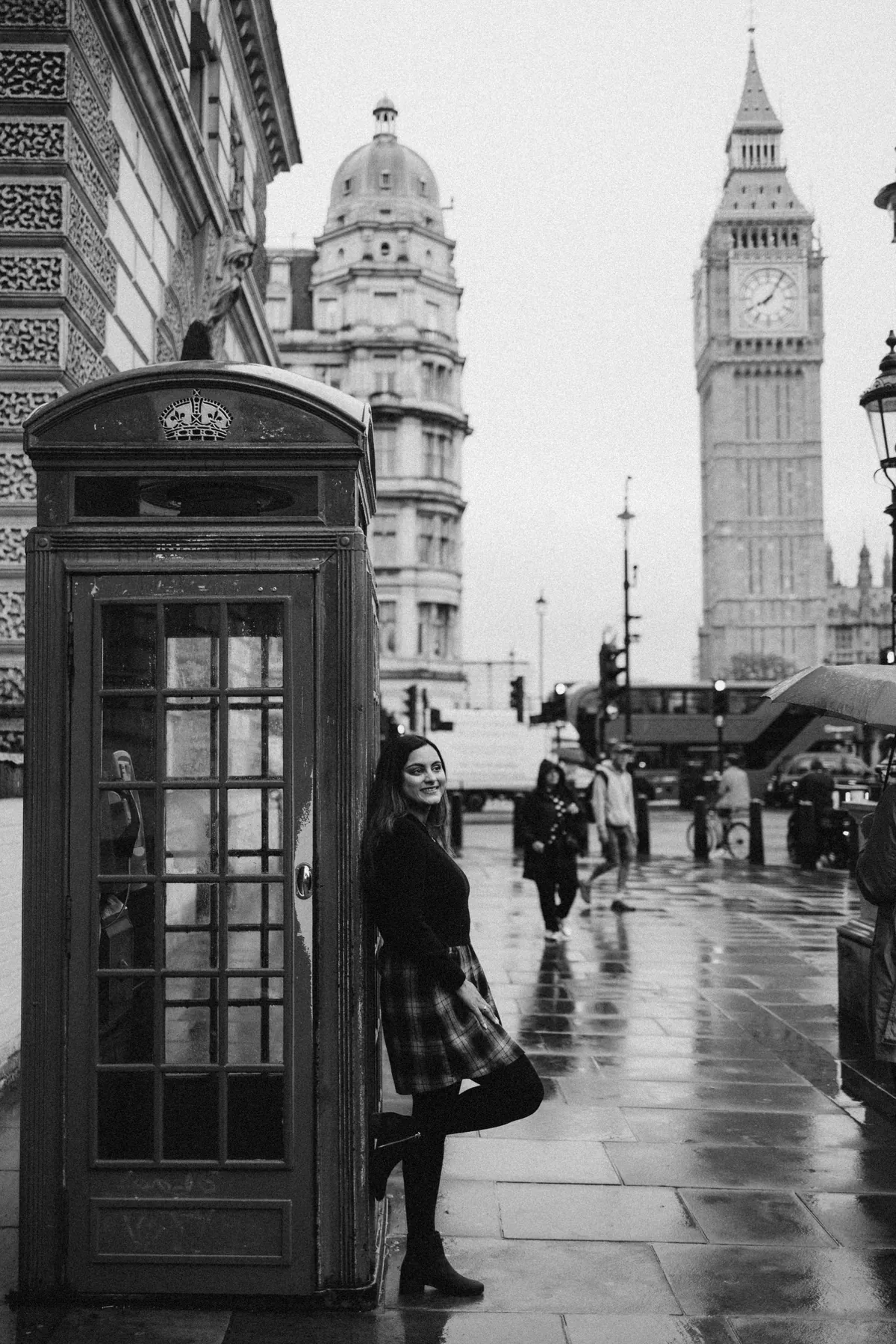
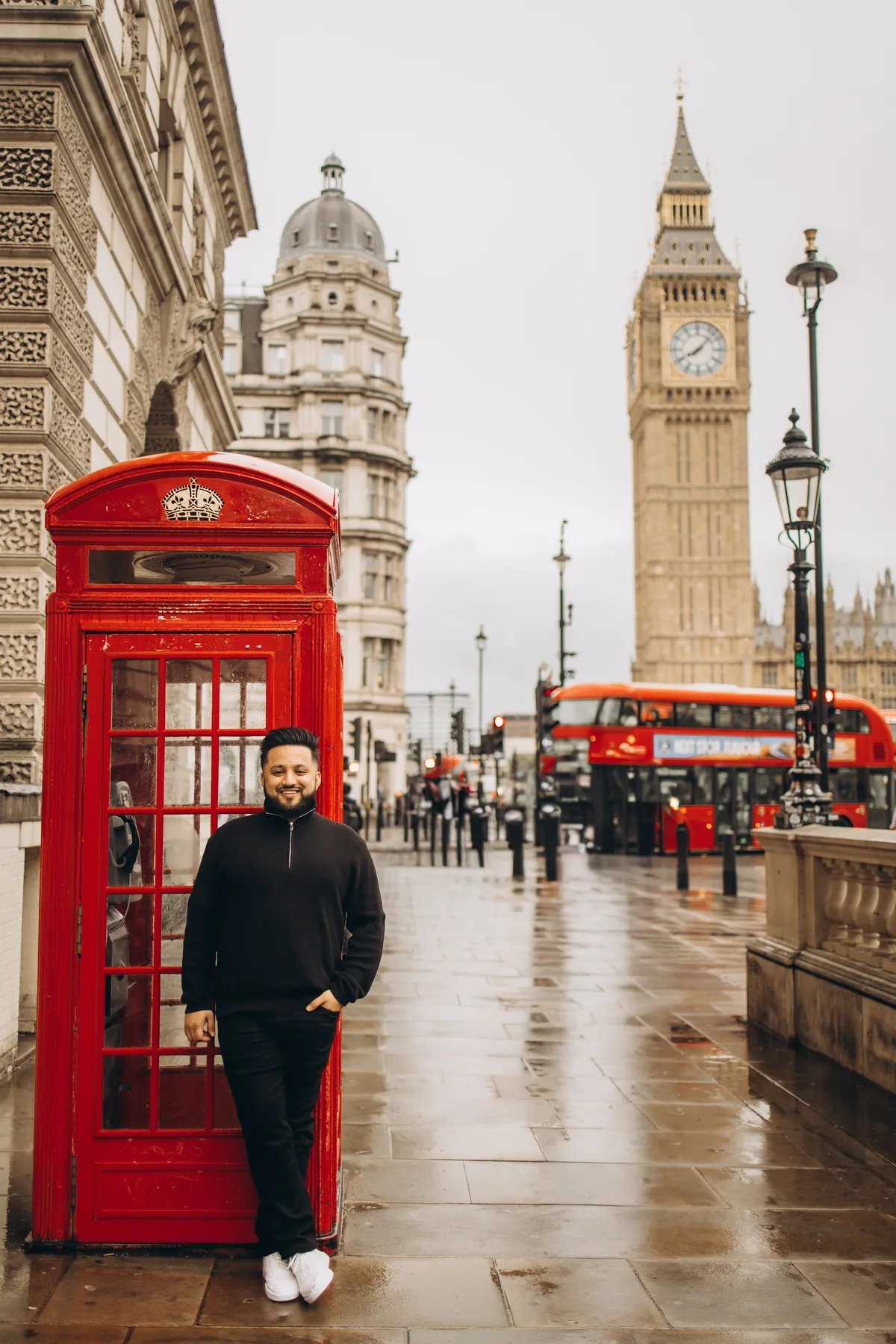
A small confession: the line was silent, as it has probably been for years. Judging by that smile, she got through anyway.
A short history of the red phone box
The box in these photos is not just a prop. It is one of the most copied pieces of design in the world, and its story starts with a competition, a cathedral architect and an argument about colour.
From a failed first try to a national icon
Britain’s first standard telephone kiosk, the K1, appeared in 1921. It was made of concrete and was widely disliked. In 1924 a competition was held for something better, and it was won by Giles Gilbert Scott, the architect of Liverpool Cathedral. His design, the K2, was a cast-iron box with a domed roof, and it is often said to echo a tomb that the Regency architect Sir John Soane designed for his wife.
Scott wanted his kiosk painted silver. The Post Office chose red instead, so it would be easy to spot on a busy street, and that decision gave London one of its most famous colours. The K2 was large and expensive, so almost all of them were installed in London.
In 1935 Scott updated the design for the Silver Jubilee of King George V. The new K6 was smaller, lighter and cheaper to make, with horizontal strips of glass instead of the K2’s grid of square panes. It went everywhere, from city streets to village greens, and it is the box most people picture when they think of a red phone box. The one by Parliament Square is a K6: count the horizontal panes in the door and look for the crown on top.
| Year | Kiosk | What changed |
|---|---|---|
| 1921 | K1 | The first national kiosk, in concrete. Not a success. |
| 1924 | K2 | Scott wins the design competition: cast iron, a domed roof, painted red. |
| 1929 | K3 | A cheaper concrete version for the rest of the country. It tended to crack. |
| 1935 | K6 | The Jubilee kiosk: smaller and lighter, and the one that went nationwide. |
| 1968 | K8 | The last of the red boxes, a plain modern design. |
Five things to tell your friends
- It was meant to be silver. Red was the Post Office’s choice, not the architect’s.
- The first K2 prototype is still standing, in timber, at the entrance to Burlington House on Piccadilly, home of the Royal Academy.
- Tens of thousands were made. Historic England counts 64,000 K6 kiosks by 1960, of which about 11,700 survive and around 2,000 are listed buildings.
- The crown is a clue. On a K6 the crown sits in relief on each side; on the older K2 it is cut through the metal as ventilation holes.
- The same architect worked on Parliament. Giles Gilbert Scott oversaw the rebuilding of the House of Commons after the Second World War, a few hundred metres from this phone box.
So when you lean on the box for a photo, you are leaning on a listed piece of 1930s industrial design. Gently, please.
Across from the London Eye
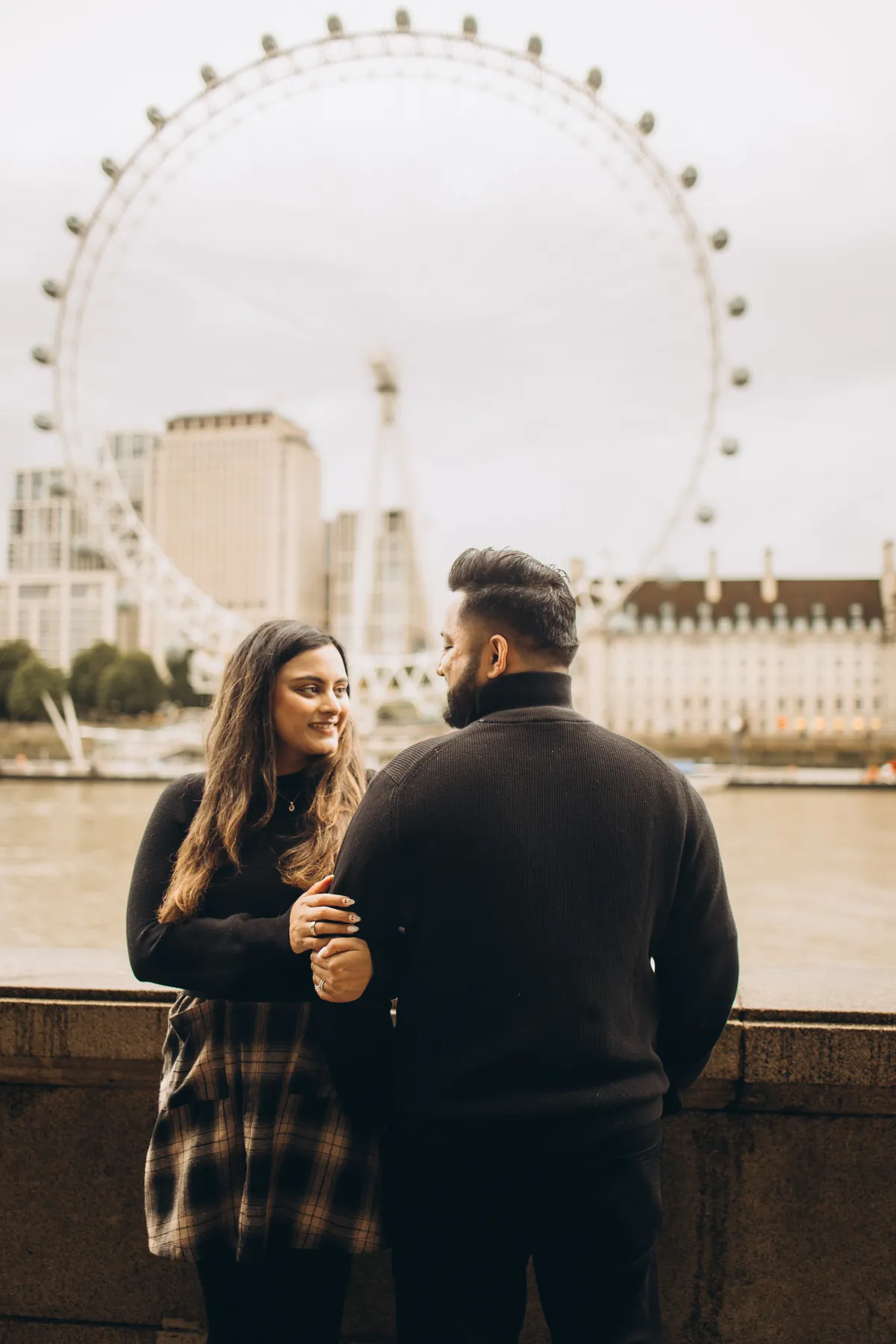
On the Westminster side of the river the wall runs along the water, with the London Eye and County Hall on the far bank. Grey sky turns the wheel into a soft white circle, a perfect frame for two people who only have eyes for each other.
Westminster Bridge in the rain
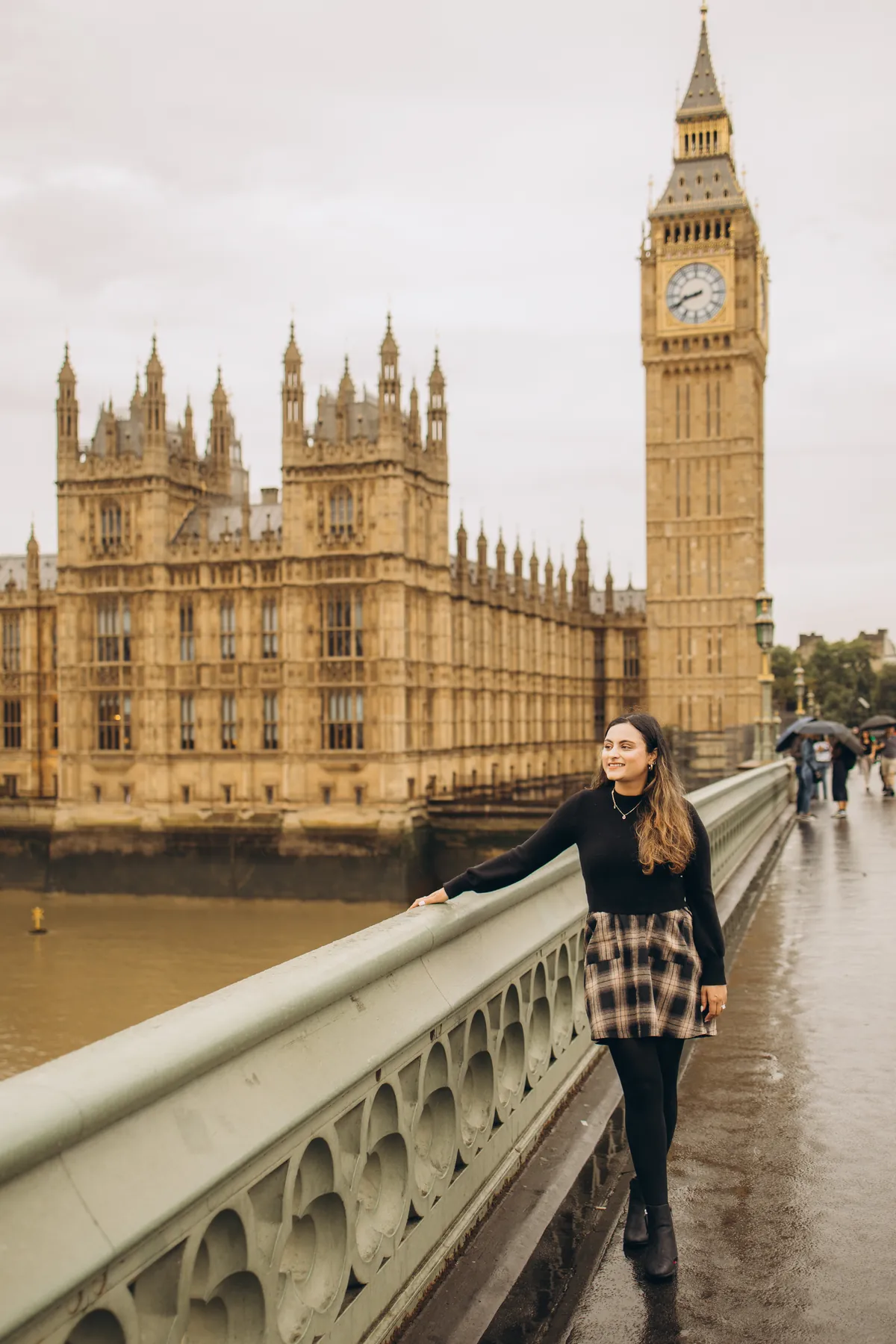
On Westminster Bridge the rain kept most people moving, which left long stretches of wet, empty pavement. One frame looks upstream along the river, the others walk back towards the tower, hand in hand, with the Houses of Parliament on one side and the traffic on the other.
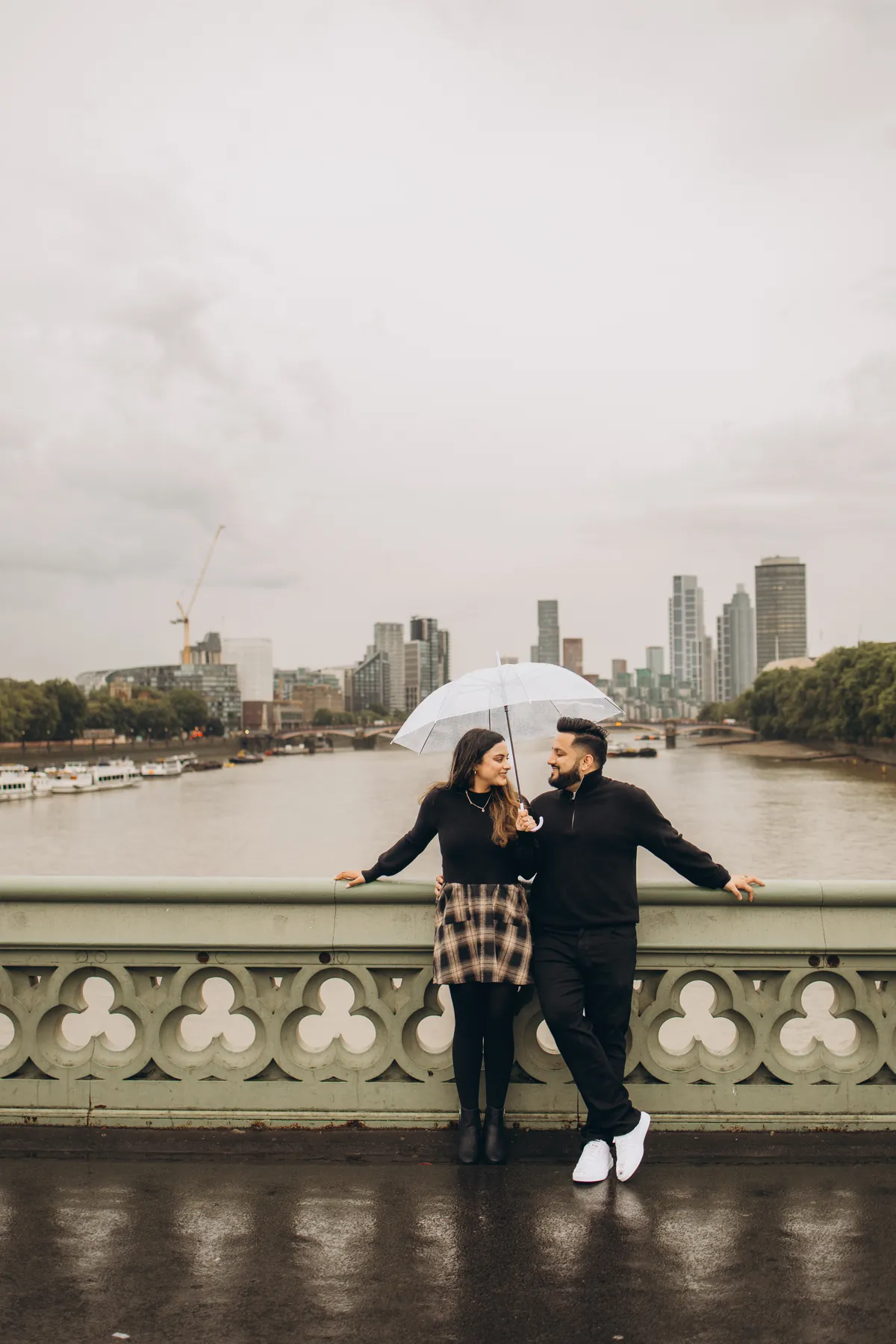
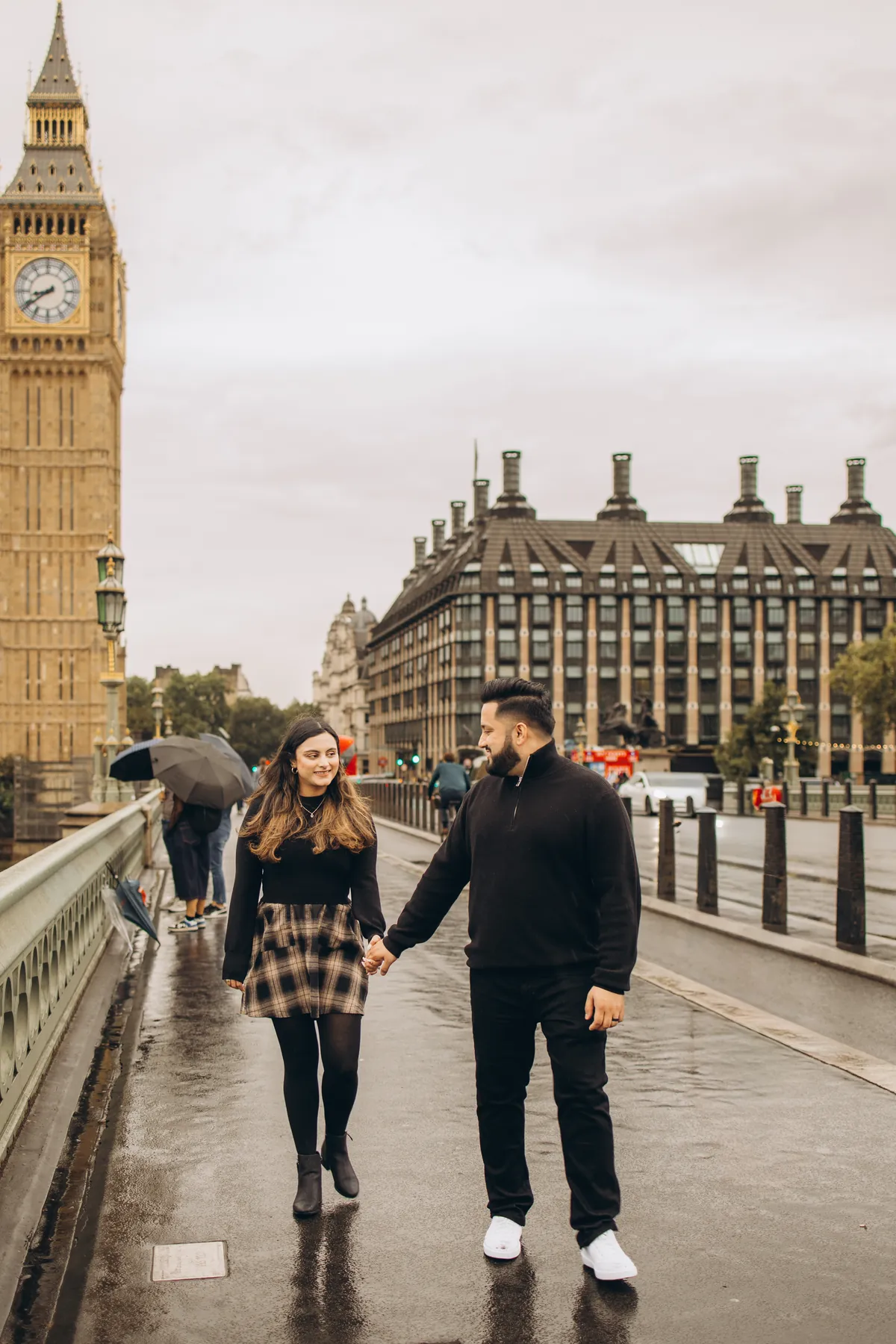
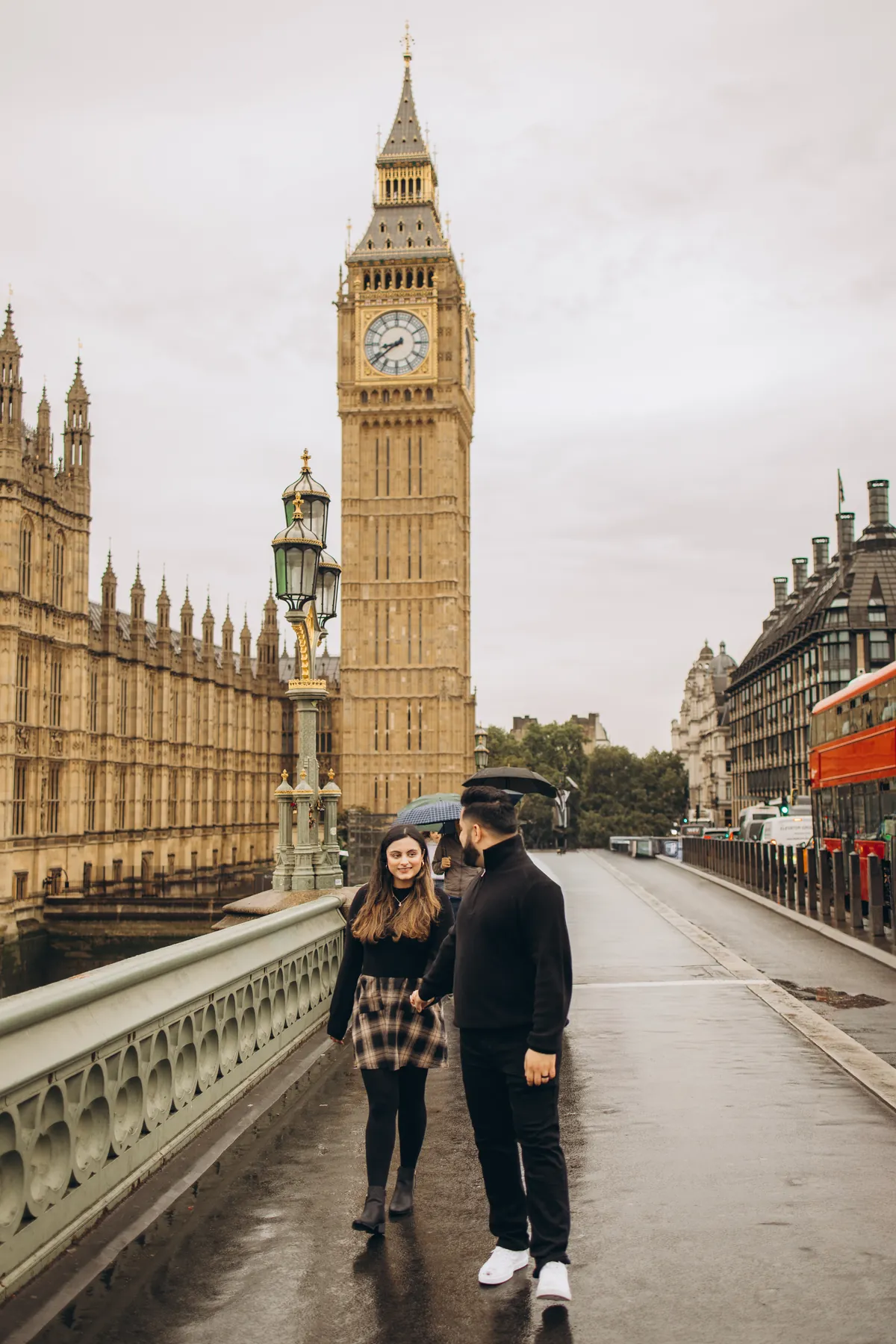
Bold choice of the day: white trainers, in the rain, in London. They were still white in the very last photo. We are not sure how.
A portrait each
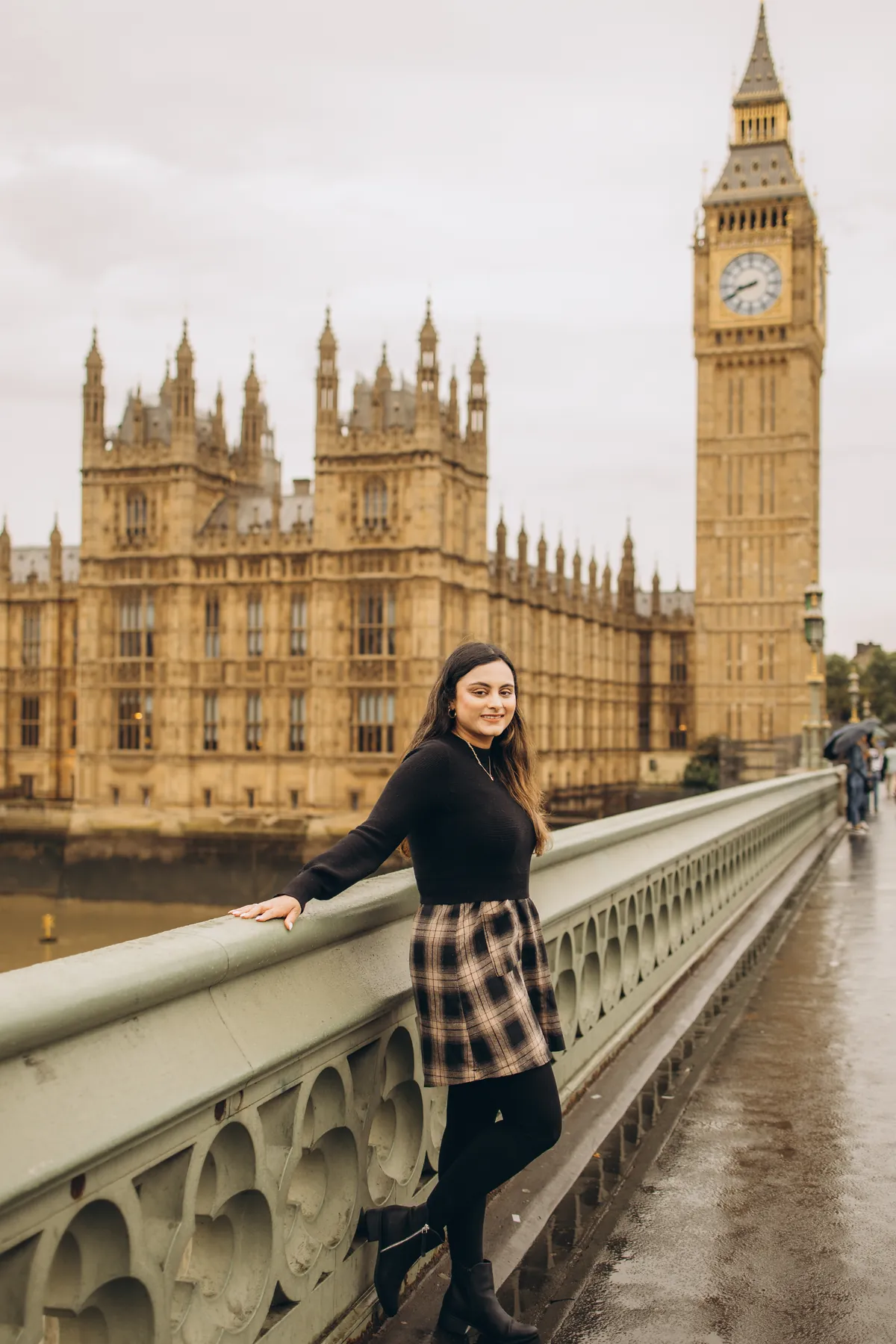
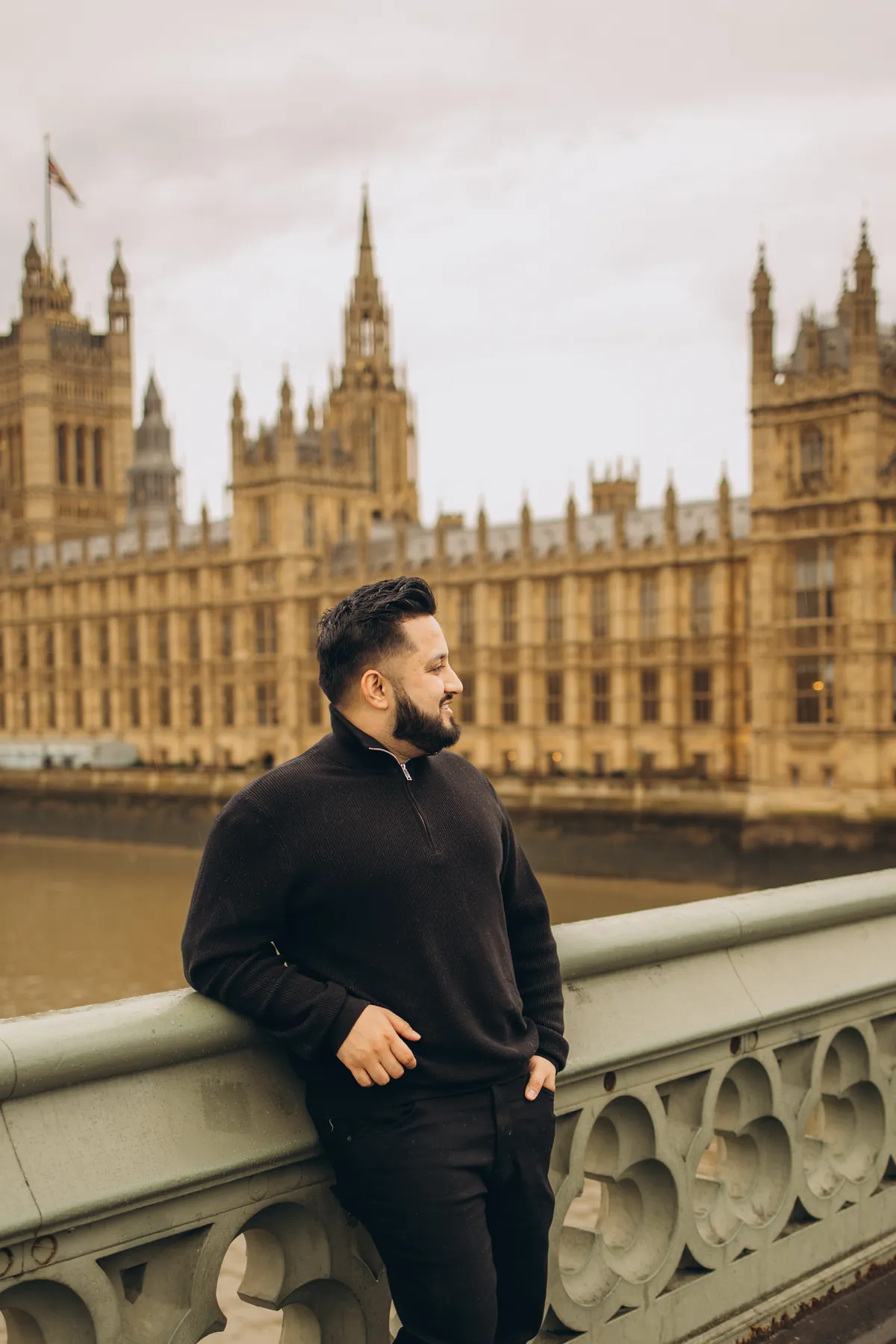
Most couples remember to ask for a solo portrait for her. This time he got one too. A few minutes each on the bridge, one hand on the green railing, the palace and the tower behind, and both of them left with a photo that is just theirs.

The arch and the river wall
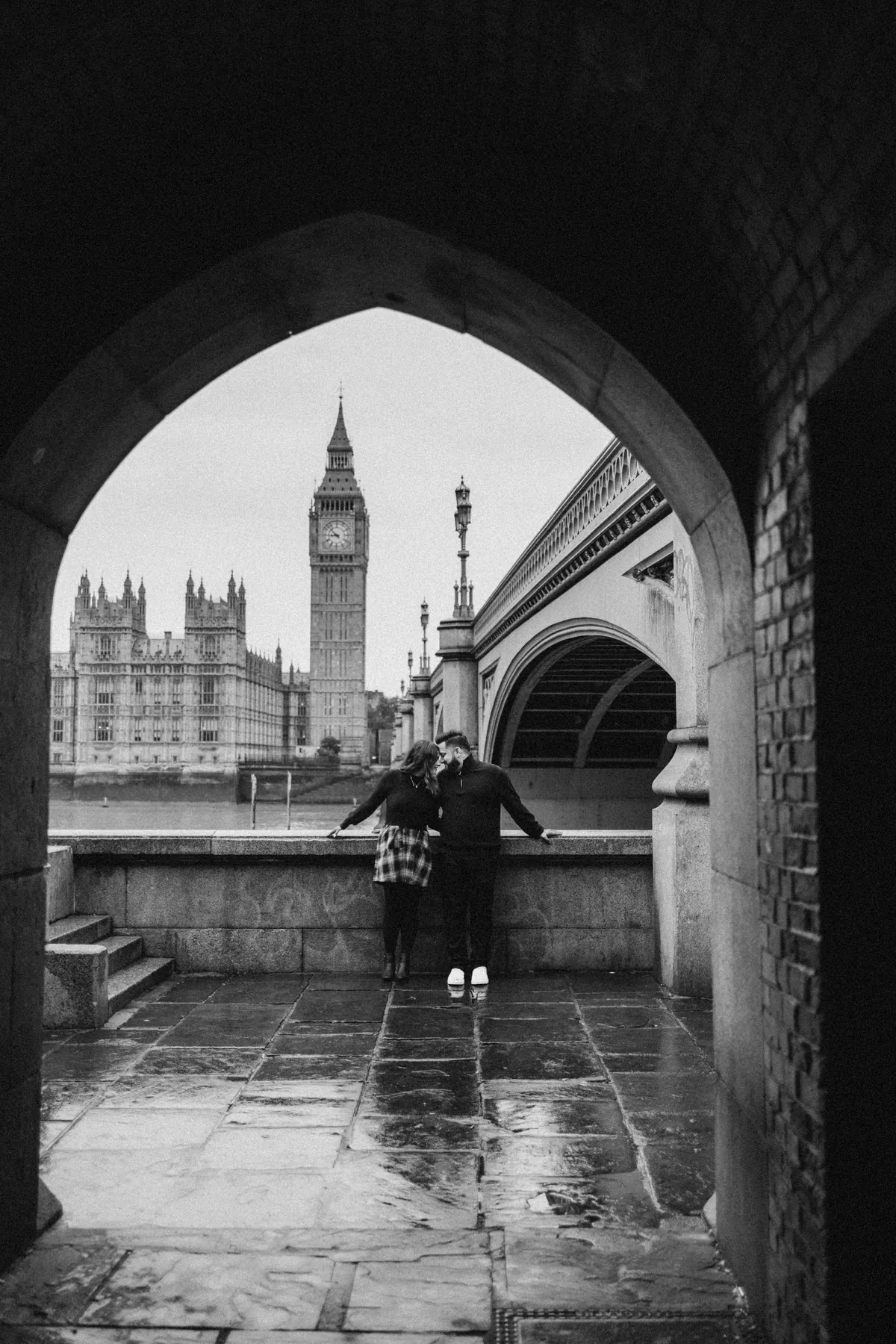
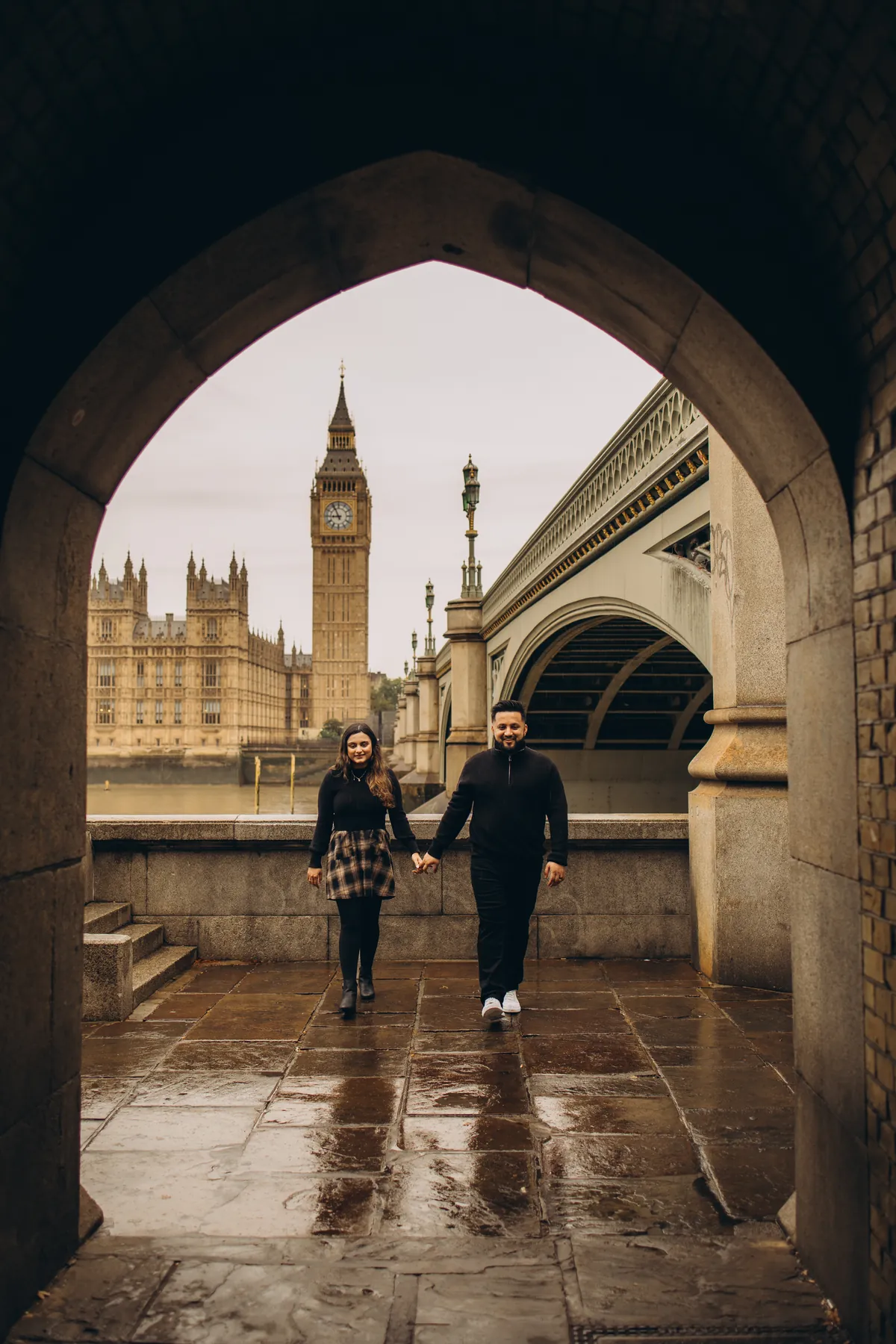
The last part of the walk crossed to the South Bank. Under the arch below the bridge the stone frames the tower across the river: one frame in black and white, heads together at the wall, and one walking out towards the camera, still hand in hand. A few steps away, on the river wall, came one more hug.
Ideas to borrow from this Big Ben photoshoot
- Match, but not exactly. Two black jumpers and one plaid skirt look coordinated without looking like a uniform.
- Ask for a portrait each. Both partners, not only one. It takes a few minutes and you both get a photo for yourself.
- Use the props London gives you. Open the phone box door, pick up the receiver, lean on the railing.
- Do not cancel for drizzle. Wet pavements reflect the tower and keep the crowds moving. If you would rather wait for a dry day, we move the session for free.
- Try one frame in black and white. Grey days are made for it, especially under the arch.
See all the spots on this walk in the Big Ben guide, pick up a few natural poses, or check the prices for a session of your own.