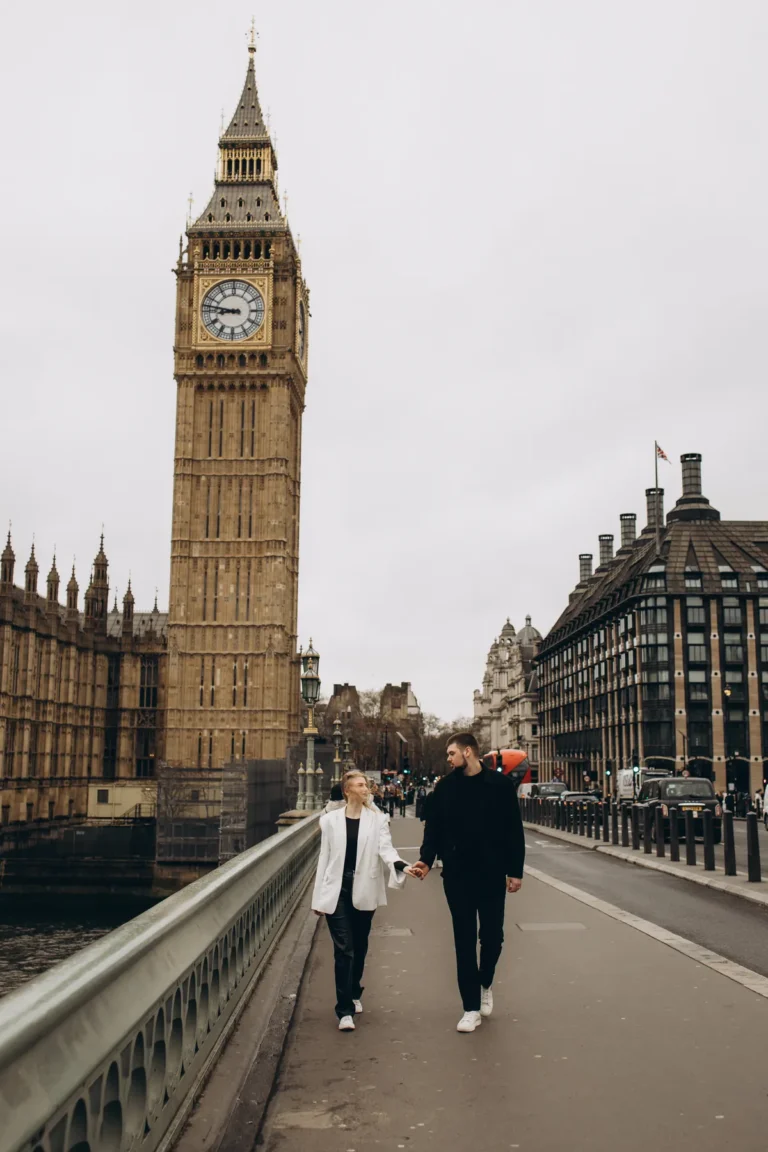
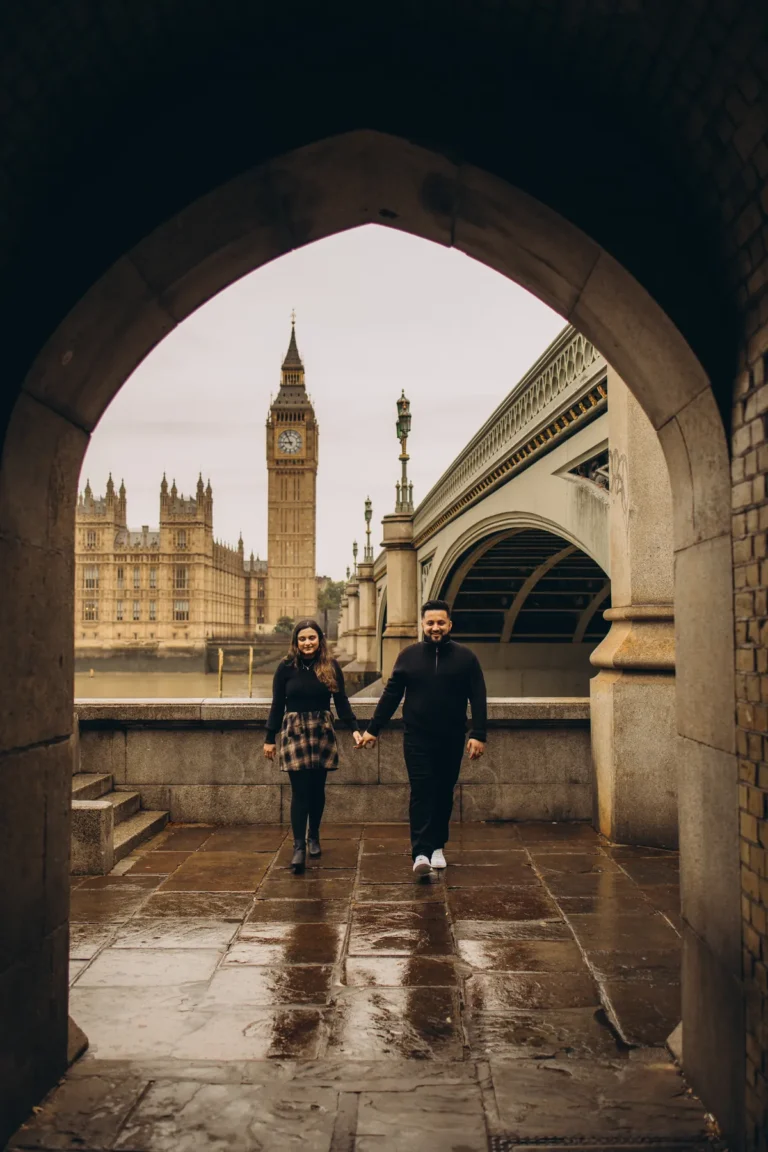
In short: Big Ben exists because of the fire of 16 October 1834, which destroyed the old Palace of Westminster. The new palace was designed by Charles Barry and the clock tower by Augustus Pugin. The clock started in May 1859 and the great bell first rang that July.
Big Ben exists because of a fire. On the evening of 16 October 1834 the old Palace of Westminster went up in flames, and London came out to watch. What rose in its place over the next quarter of a century was the building you see behind every Big Ben photoshoot today: a new Gothic palace, a clock that had to be right to the second, and a bell that cracked twice before it rang for good.
This is that story, told in paintings and prints of the time, and ending on the riverbank where our couples stand for their photos.
In this story:
- 16 October 1834: the night Westminster burned
- A competition for a new palace
- Pugin’s last design
- A clock that had to be right to the second
- Two bells and two cracks
- Painted in fog
- The bank where Turner stood
- Timeline
16 October 1834: the night Westminster burned
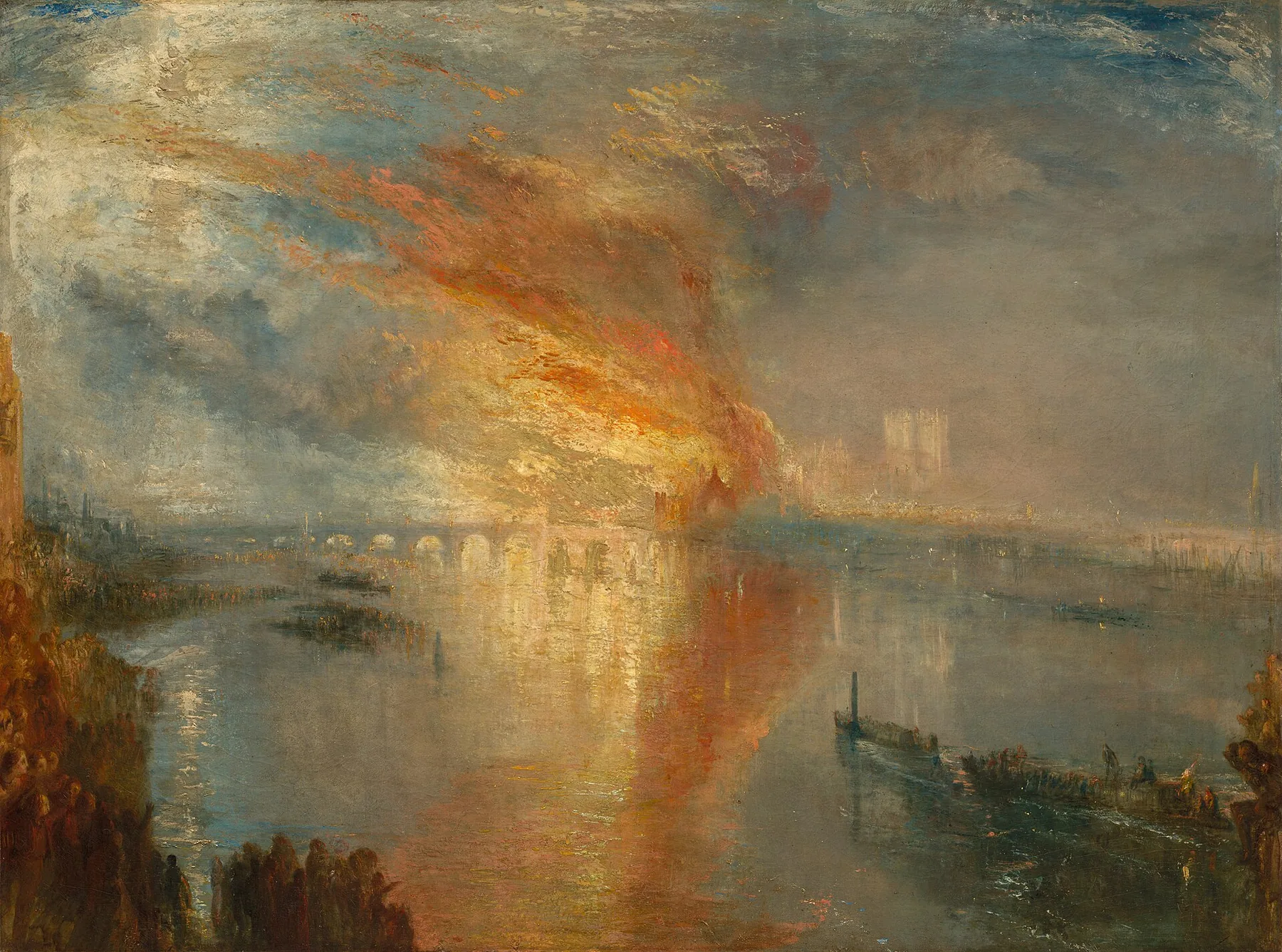
The fire started in the most bureaucratic way imaginable. For centuries the Exchequer had kept its accounts on tally sticks, notched pieces of wood split in two so that each side held a matching half. The system had long been retired, and in October 1834 workmen were told to get rid of the old sticks by burning them in the stoves beneath the House of Lords. They burned too many, too fast. By evening the flues were overheated and the building above them was alight.
It became the biggest fire London had seen between the Great Fire of 1666 and the Blitz. Crowds packed the bridges and both banks of the river. Among them was the painter J. M. W. Turner, who watched from the south bank and later turned what he saw into two famous canvases, one now in Philadelphia and the one above in Cleveland. Look closely at the painting: the bridge glows in the reflected light, and the dark figures in the foreground are the crowd.
Most of the medieval palace was lost that night. Westminster Hall, the great hall from the eleventh century, was saved and still stands inside the palace today.
A competition for a new palace
Parliament decided not to patch the ruins but to build again, and in 1835 it announced a competition. Entries had to be in the Gothic or Elizabethan style, a deliberate choice of something that looked old and English. The winner was the architect Charles Barry. His plan gave the palace its long river front, but the Gothic detail that covers almost every surface, from the window tracery to the clock faces, came from a young designer he brought in to help: Augustus Welby Northmore Pugin.
Work on the new palace began around 1840. The clock tower at its north end, next to Westminster Bridge, was started in 1843.
Pugin’s last design
Pugin was obsessive, brilliant and exhausted. In early 1852 he produced the final drawings for the clock tower, the tall, slender tower with the gilded clock faces and the spire on top that is now the most photographed part of London. Within days he suffered a breakdown and was taken into care. He died in September of the same year, aged just forty.
So the tower in the background of every photo on this site is, in a sense, a farewell: the last great design of the man who gave the whole palace its look.
A clock that had to be right to the second
The clock was almost as difficult as the tower. The Astronomer Royal, George Airy, insisted that the first stroke of each hour should be accurate to within one second, a demand many clockmakers thought impossible for a public clock of that size. The design that met it came from Edmund Beckett Denison, a lawyer and amateur clock expert, and the clock was built by the firm of Dent.
The Great Clock started keeping time on 31 May 1859. Its accuracy is still fine-tuned in a wonderfully simple way: small coins stacked on the pendulum. Adding a single old penny changes the rate slightly, by a fraction of a second a day.
Two bells and two cracks
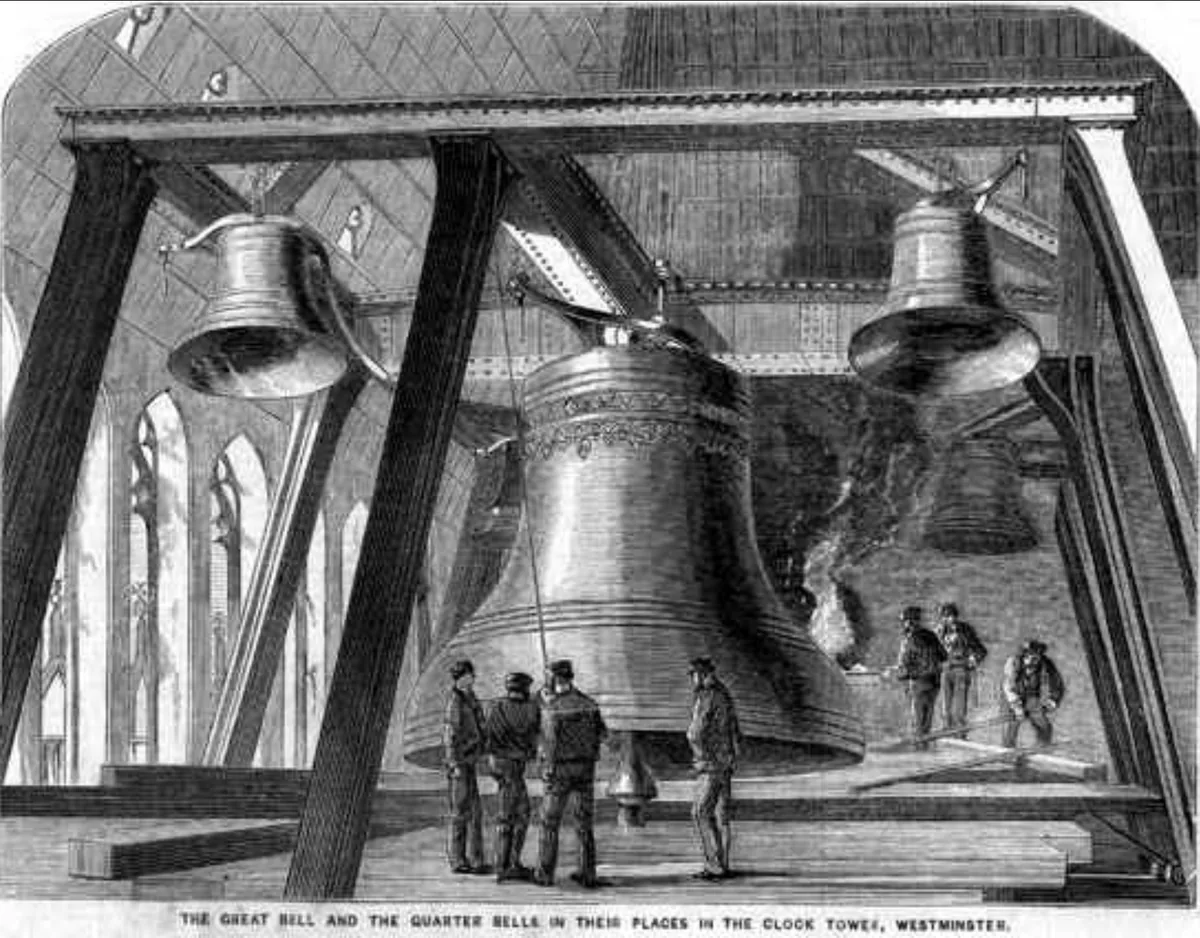
The first great bell was cast in 1856 in Stockton-on-Tees. It cracked while it was being tested, before it ever reached the tower. A second bell was cast in 1858 at the Whitechapel foundry in east London, hauled up inside the tower, and hung in the belfry you see in the engraving above, with the four smaller quarter bells around it.
It first rang in July 1859. By September it had cracked too. For the next few years the hours were struck on one of the quarter bells, until in 1863 the great bell was given a quarter turn, so the hammer would strike an undamaged spot, and a lighter hammer. It has rung with that crack ever since, which is part of the reason for its unusual sound.
Why “Big Ben”? Nobody is completely sure. The most popular explanation is that it was named after Sir Benjamin Hall, the commissioner of works when the bell was made. Strictly, the name still belongs to the bell, not the tower, which became Elizabeth Tower in 2012.
Painted in fog
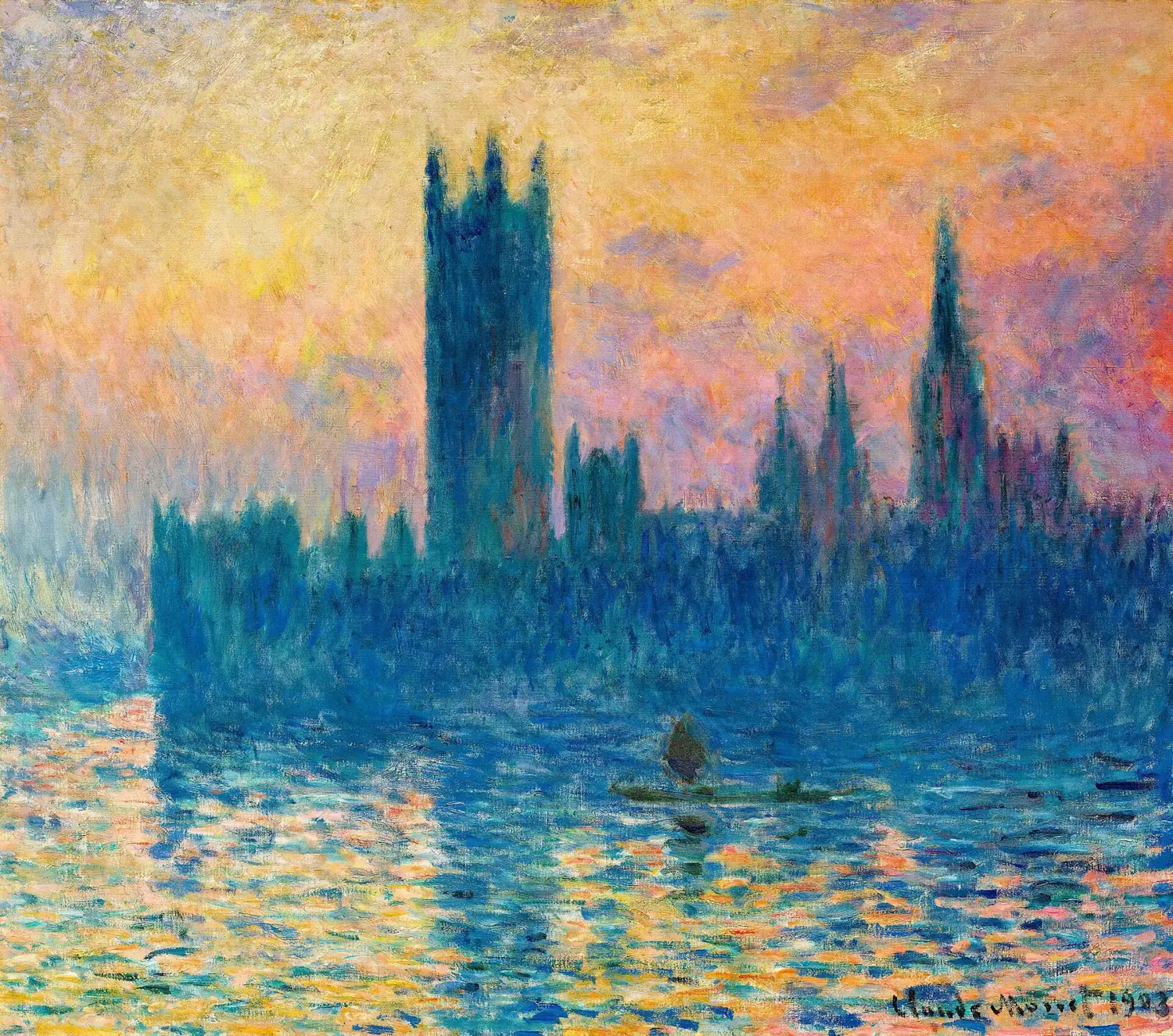
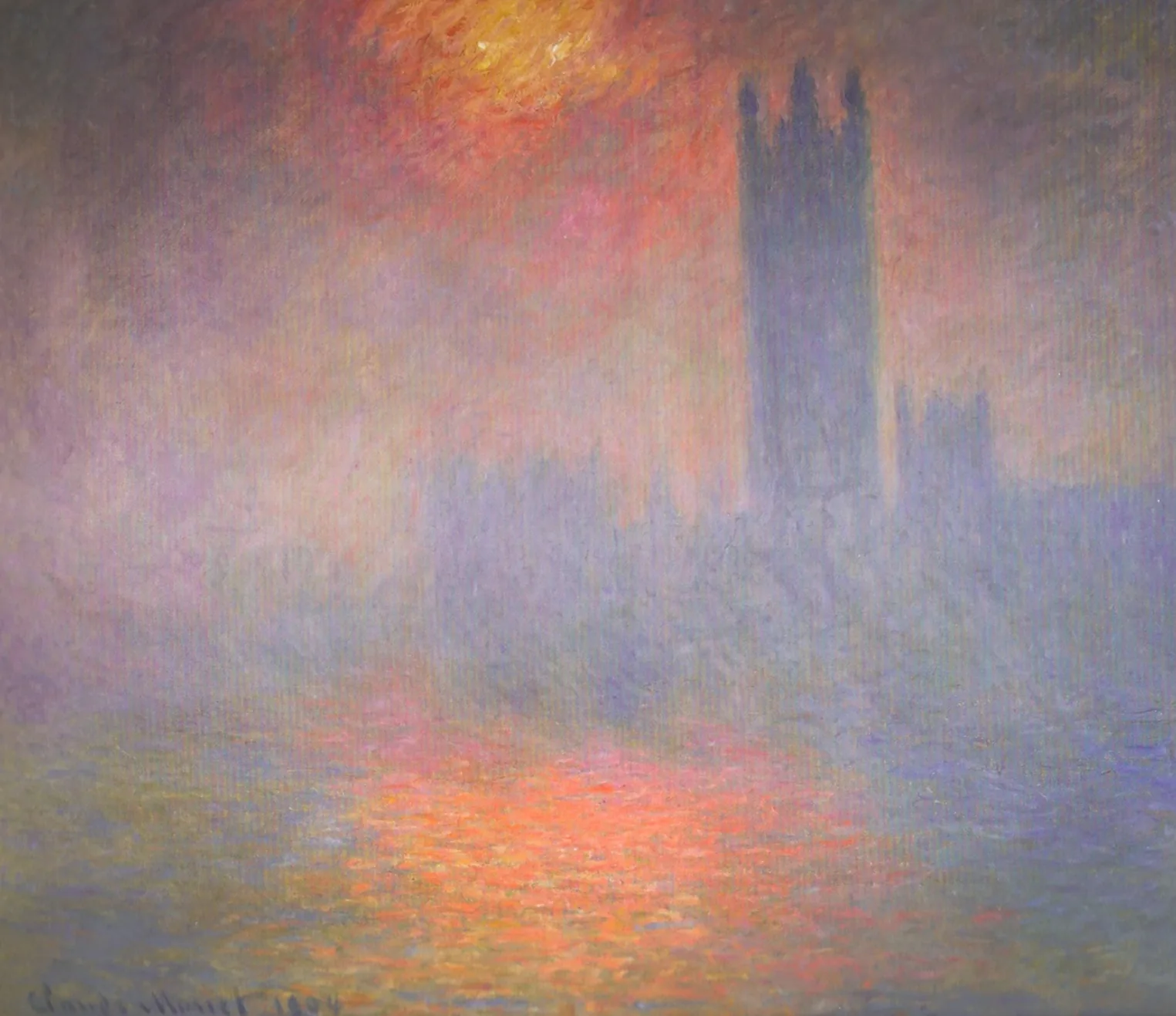
Seventy years after Turner, another painter came to the same river for the same building. At the start of the twentieth century Claude Monet painted the Houses of Parliament again and again from across the Thames, in sunsets, fog and smoke, finishing the canvases back in France. The palace hardly changes from one painting to the next. The light changes completely.
That is still true today. The same tower looks honey-coloured in the morning, dark against a sunset and silver in the rain. The best time to photograph Big Ben explains how the light moves through the day.
The bank where Turner stood
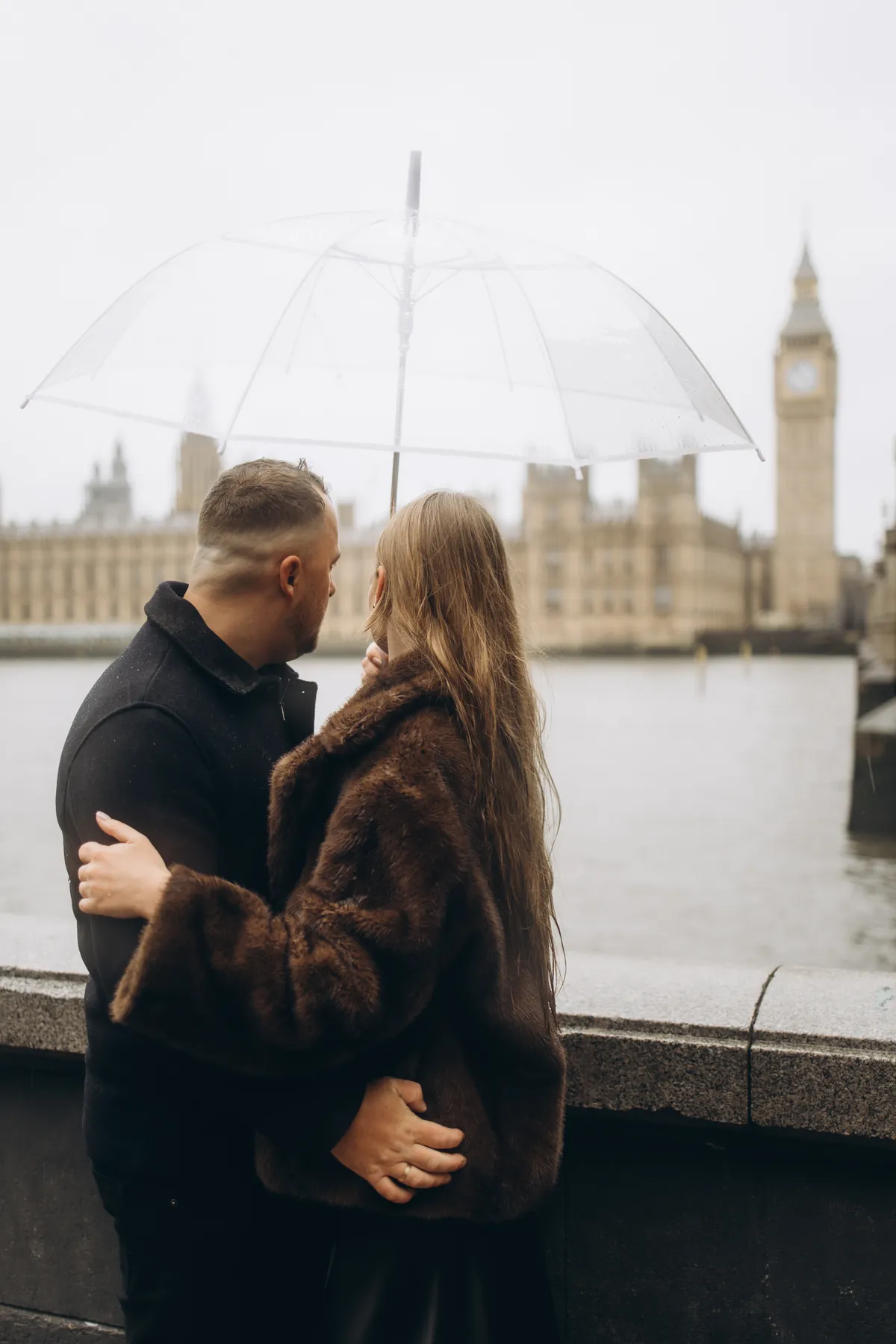
In 1834 the crowds on the south bank watched Parliament burn. Today the same riverside is one of the best places to photograph Big Ben: the whole palace fits in the frame, the tower stands at one end and Westminster Bridge at the other. The building survived its own fire, the bells survived their cracks, and in May 1941 a bomb destroyed the House of Commons chamber while the clock kept on going.
If you have a story of your own to add to the place, a Big Ben photoshoot starts at £150. Planning a proposal? Read how to propose at Big Ben.
Timeline: from fire to bell
| Year | What happened |
|---|---|
| 1834 | Fire destroys most of the old Palace of Westminster on 16 October. Westminster Hall survives. |
| 1835–1836 | A competition for the new palace, won by Charles Barry, with Augustus Pugin on the Gothic detail. |
| 1843 | Work begins on the clock tower. |
| 1852 | Pugin completes the tower design, then falls ill. He dies in September. |
| 1856 | The first great bell is cast in Stockton-on-Tees and cracks during testing. |
| 1858 | The second bell is cast at Whitechapel and hung in the tower. |
| 1859 | The clock starts on 31 May. The bell rings in July and cracks in September. |
| 1863 | The bell is turned and given a lighter hammer. It still rings today. |
| 1903–1904 | Claude Monet paints his series of the Houses of Parliament. |
| 2012 | The Clock Tower is renamed Elizabeth Tower. |
Questions about Big Ben’s history
Did Big Ben burn in the 1834 fire?
No. The tower did not exist yet. The fire destroyed the old palace, and the clock tower was built afterwards as part of the new one, starting in 1843.
Who designed Big Ben?
The palace was designed by Charles Barry, and the clock tower itself by Augustus Pugin, in one of his last works. The clock mechanism was designed by Edmund Beckett Denison and built by Dent.
Why is it called Big Ben?
The name belongs to the great bell. The most common explanation is that it honours Sir Benjamin Hall, commissioner of works at the time, but no one knows for certain.
Where can I see Turner’s paintings of the fire?
Turner painted the fire twice. One version is in the Philadelphia Museum of Art and the other in the Cleveland Museum of Art in the United States.